Guides, Answers and Downloads

Guides, Answers and Downloads

Resources

Everything you need to evaluate, install and run a BioSpeed: guides to download, straight answers to the questions buyers ask, videos and further reading.

[

Downloads

]

Guides You Can Keep

Guides You Can Keep

Guides You Can Keep

Each one is a PDF. Download what you need, or ask your BioCoTech representative for the full set.

Each one is a PDF. Download what you need, or ask your BioCoTech representative for the full set.

PDF

PDF

PDF

PDF

BioSpeed Product Brochure

BioSpeed Product Brochure

Sizing, specifications and options for the M1, M2, M4 and M18.

Sizing, specifications and options for the M1, M2, M4 and M18.

Sizing, specifications and options for the M1, M2, M4 and M18.

PDF

PDF

PDF

PDF

Operator Quick Reference and Daily Checklist

Operator Quick Reference and Daily Checklist

The daily checks and loading rules to post beside the machine.

The daily checks and loading rules to post beside the machine.

The daily checks and loading rules to post beside the machine.

PDF

PDF

PDF

PDF

Client Feedstock Guide

Client Feedstock Guide

What to load, in what ratio, including PLA, bamboo and high-carbon materials.

What to load, in what ratio, including PLA, bamboo and high-carbon materials.

What to load, in what ratio, including PLA, bamboo and high-carbon materials.

PDF

PDF

PDF

PDF

Soil Usage Statement

Compost Usage Statement

Compost Usage Statement

How to use the soil amendment, including ratios for outdoor soil.

How to use the soil amendment, including ratios for outdoor soil.

How to use the soil amendment, including ratios for outdoor soil.

Web

Web

Web

Web

EPA Composting Resources

EPA Composting Resources

A deeper look at compost and its uses, from the U.S. EPA.

A deeper look at compost and its uses, from the U.S. EPA.

A deeper look at compost and its uses, from the U.S. EPA.

[

Frequently Asked Questions

]

Straight Answers

Straight Answers

Straight Answers

The questions we hear most, grouped by topic. Can't find yours? Call (720) 483-1990.

The questions we hear most, grouped by topic. Can't find yours? Call (720) 483-1990.

The Basics

What can go in it?

Anything organic, which is usually the largest part of a waste stream. That includes any food, agricultural waste, paper towels, manures and most compostable cutlery, plates and cups. Large bones and shells must be ground.

How does BioSpeed compost so fast?

We are simply optimizing a natural process. The on-board computer watches the variables that matter. Heat sensors keep the mass at 70 to 80 degrees Celsius with a culture of heat-loving microbes, paddles turn the mass so microbes get oxygen, and ventilation pulls air through and carries out water vapor and CO₂.

What feedstock mix do you recommend?

We generally recommend 60–80% diversified food waste and 20–40% carbon-rich organic material. A diversified food stream helps reach the ideal 25:1 carbon to nitrogen ratio. See the Feedstock Guide for details.

Can it process PLA?

Yes, BioSpeed accepts PLA. Use certified compostable PLA items such as cutlery, cups and plates, and balance them with dry carbon like any other feedstock. Products vary, so we review the specific items you plan to load during your site assessment.

What can go in it?

Anything organic, which is usually the largest part of a waste stream. That includes any food, agricultural waste, paper towels, manures and most compostable cutlery, plates and cups. Large bones and shells must be ground.

How does BioSpeed compost so fast?

We are simply optimizing a natural process. The on-board computer watches the variables that matter. Heat sensors keep the mass at 70 to 80 degrees Celsius with a culture of heat-loving microbes, paddles turn the mass so microbes get oxygen, and ventilation pulls air through and carries out water vapor and CO₂.

What feedstock mix do you recommend?

We generally recommend 60–80% diversified food waste and 20–40% carbon-rich organic material. A diversified food stream helps reach the ideal 25:1 carbon to nitrogen ratio. See the Feedstock Guide for details.

Running It

What do I have to do each day?

It is as easy as taking out the trash. Wheel your food waste over, attach the bin to the hydraulic lift or load by hand, and let the machine do the rest.

How much material will I get?

Expect a 70–90% reduction in volume. Load a 64-gallon toter every day and you will remove one toter of immature compost every 7 to 9 days. For every cubic yard in, you get 0.3 cubic yards or less out.

How do you handle contaminants?

Separation grates address contamination. Check for contaminants daily and remove them when you can. Small items that pass through can be taken out after dispensing.

Will it work in a cold climate?

Yes. The machines were developed in Scandinavia, with two layers of thick steel separated by heavy insulation and convection heating. Protect the digital display from weather.

Will it smell or attract pests?

The in-vessel design makes it hard for pests to get in, and the aerobic process avoids the odors of airless decomposition. Ask about the activated charcoal filter for the small amount of odor that remains.

What do I have to do each day?

It is as easy as taking out the trash. Wheel your food waste over, attach the bin to the hydraulic lift or load by hand, and let the machine do the rest.

How much material will I get?

Expect a 70–90% reduction in volume. Load a 64-gallon toter every day and you will remove one toter of immature compost every 7 to 9 days. For every cubic yard in, you get 0.3 cubic yards or less out.

How do you handle contaminants?

Separation grates address contamination. Check for contaminants daily and remove them when you can. Small items that pass through can be taken out after dispensing.

The Compost

What do I do with the material?

Use it as an immature compost or soil amendment on green space, partner with a local nonprofit or farm to collect it, package and sell it, or have it hauled away to a compost facility. Permits and testing may be required and vary by state.

How good is the material?

The quality of the compost depends on a variety of factors, including the feedstock, processing period, maturity and more. There is no standard output.

Should we worry about salinity?

Usually it is a low concern, but salt content varies with what you feed the machine. We recommend lab testing. High-salt material still works well with well-draining soils or salt-tolerant plants.

Cost and Support

What is the expected payback?

It varies by site. A 10-year return of 100% to 500% with break-even in 1 to 5 years is not uncommon.

Are there incentives or subsidies?

Often yes, including grants, tax credits and waste reduction programs. Contact your local environmental agencies, and tell us your state when you request a quote.

What does it cost to run?

Beyond the optional Service and Maintenance Program, the only recurring part is the gearbox grease cartridge, replaced yearly. Units last 15 years or more with proper maintenance.

What is the warranty?

Every BioSpeed comes with a one-year parts and labor warranty.

What is the expected payback?

It varies by site. A 10-year return of 100% to 500% with break-even in 1 to 5 years is not uncommon.

Are there incentives or subsidies?

Often yes, including grants, tax credits and waste reduction programs. Contact your local environmental agencies, and tell us your state when you request a quote.

What does it cost to run?

Beyond the optional Service and Maintenance Program, the only recurring part is the gearbox grease cartridge, replaced yearly. Units last 15 years or more with proper maintenance.

Safety

Is it safe?

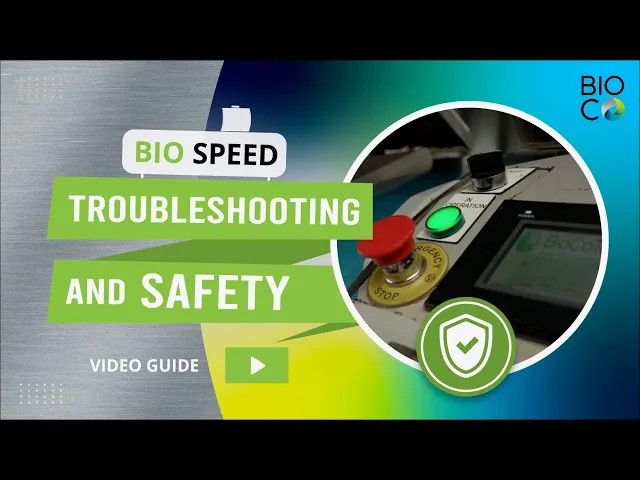
Yes. Every unit has motor alarm feedback, torque sensors, a high temperature switch, a manual emergency stop, an open hatch switch, automatic standby, automatic power-up after power loss, an alarm record and a fault lamp. K-12 students operate it with minimal supervision.

Does the unit track how much waste it processes?

Not by itself. We advise on easy ways to collect the data, and a waste-data partnership is under way.

[

Watch

]

See BioSpeed in Action

See BioSpeed in Action

See BioSpeed in Action

Start with the 2-minute overview, then explore the units on real sites.

Start with the 2-minute overview, then explore the units on real sites.

[

From the Blog

]

Latest Articles

Latest Articles

Latest Articles

News and ideas on composting, food waste rules and sustainable operations.

News and ideas on composting, food waste rules and sustainable operations.

FROM THE FIELD

What buyers ask before they install

What buyers ask before they install

What buyers ask before they install

What buyers ask before they install

What a BioSpeed install needs

An install takes our technician 1 to 2 days on site. The site needs flat, level concrete that can take a forklift, and shelter indoors or under an awning, a short walk from where the waste is made. Power is a dedicated circuit: 30 A for the M1 and M2, 40 A for the M4, three-phase for the M18. A PVC vent runs to the outdoors, sloped to a condensate trap. Leave 2 ft at the sides and front and 1.5 ft behind an M1, M2 or M4, and about 4 ft around an M18.

Who runs it, and for how long

A trained operator spends about 5 to 10 minutes a day, plus loading time. Check the green light and material temperature, look inside, load food scraps mixed with dry carbon, then swap the output bin, check the vent and log the load. The machine does not measure throughput, so your log is your diversion record. Plan for a named operator and a backup.

Does it keep working in winter?

Yes, if it is housed right. Heating elements hold the material at about 149 to 162°F inside an insulated stainless steel body, so cold air outside is not the problem. Keep the machine indoors or under an awning and protect the display. The prefabricated container option arrives with ventilation, lighting and wiring installed and needs one electrical connection. In snow country, check the vent outlet after every storm.

MAINTENANCE AND MATERIALS

Ask for the maintenance calendar before you buy

Ask for the maintenance calendar before you buy

Ask for the maintenance calendar before you buy

Ask for the maintenance calendar before you buy

The BioSpeed maintenance calendar

Daily: a 5 to 10 minute check before loading. Steady green light, material temperature in range, fan running, paddles visible above the material, separation grid clear, contaminants pulled out. Weekly: walk around the hatch seal, emergency stop, vent line and load log. Every 3 months: clean the extraction fan and vent. Every 6 months: grease the output auger. Every 12 months: replace the two bearing lubricators, plus an annual service by a technician. The first service visit comes about six months after installation. Trained staff can handle the quarterly, six-month and lubricator tasks with the machine locked out. Electrical work and the annual service go to a BCTA certified technician. This calendar is for the M1, M2 and M4. The M18 is maintained under its service plan.

Compostable cups, lids and clamshells

They only work if something actually composts them. A 2025 USDA technical report found 29% of composting facilities do not accept compostables at all, and a 2023 BioCycle and Composting Consortium survey found only 31% of food waste composters accept bioplastic coated paper. Compostable plastics like PLA are designed for thermophilic composting, and the lab test used to certify them (ASTM D5338) runs at about 136°F. Inside a BioSpeed, heating elements hold the material at about 149 to 162°F and a paddle shaft mixes it continuously, so every part of the load gets the heat. Tell us what serviceware you use and we will tell you how it runs.

REGULATIONS TO KNOW

Rules are pushing organics out of the garbage

Rules are pushing organics out of the garbage

Rules are pushing organics out of the garbage

Rules are pushing organics out of the garbage

California: SB 1383

SB 1383 requires businesses and jurisdictions to keep organic waste out of landfills. CalRecycle’s own analysis found the state’s permitted facilities accept about 6 million tons of organics a year, with roughly 4 million tons of additional permitted capacity, and that this is not sufficient to meet the targets. Waste Dive reported in 2024 that the state still needs about 50 to 100 new composting facilities. On-site processing adds capacity where the waste is made. It does not replace regional infrastructure.

New York City: Int. 31

Passed June 30, Int. 31 lets DSNY extend the commercial organics rules to more food businesses, with a decision due by December 1. Businesses already covered can hire a carter, self transport, or process on site. On-site processing must be in-vessel composting or another DSNY approved method. New equipment is registered with DSNY within 30 days of installation and renewed yearly, a DSNY decal is posted, and records are kept for three years.

Connecticut: K–12 schools

Since July 1, 2026, Public Act 24-45 brings some public and nonpublic schools under the rules for large food waste generators. Two tests decide it: an average projected 26 tons a year or more of source separated organics, and an authorized composting facility within 20 miles. Your generation rate counts before any on-site processing, donation or dehydration. On-site composting is a listed way to comply. A dehydrator alone does not count, because DEEP says the material that comes out is still solid waste unless it is further composted or digested.

Washington: business organics

Under RCW 70A.205.545, a business inside a Business Organics Management Area can’t put organic material waste in the garbage once it generates 96 gallons or more a week. That threshold took effect January 1, 2026. Since July 1, 2026, civil penalties of $500 to $1,000 a day are possible, only after a notification letter and a notice of violation. The law lists several ways to comply, including managing organics on site. Our smallest unit, the BioSpeed M1, is sized for about 40 to 120 gallons of food waste a day.

Summarized from public agency sources and our own posts as of November 2026. Rules change, so confirm current requirements with your regulator.

[

Site Assessment

]

Still Have Questions?

Still Have Questions?

Still Have Questions?

Tell us what you generate and where it is collected. We will recommend a system and outline the next steps.

Tell us what you generate and where it is collected. We will recommend a system and outline the next steps.

BioCoTech Americas brings BioSpeed in-vessel composting to stadiums, parks, resorts and campuses. Our automated systems turn food scraps into a nutrient-rich soil amendment, right on site.

Contact

© 2026 BioCoTech Americas. Specifications are approximate, vary by configuration and are subject to change.

Back to top